/ private beta · limited seats

AI decks true to your brand.
And numbers true to your source.

Generic AI stops at "close enough" — on your identity, and on your figures. If that works for you, you don't need us. Effigo is for teams whose decks show up in a suit. Native PowerPoint, on-brand to the pixel and every number traceable.

No spam. Just the beta invite.
/ how it works

One deck to learn your brand.
Then just send the story.

Once

Send a deck you love

Effigo builds your brand profile from it: layout system, type, colors, decorative language — and the voice your company writes in.

brand_deck.pptx · the brand
Every deck after

Send the story — and the numbers

Your argument in plain text, the way you'd brief a colleague. Attach your spreadsheet and every figure in the deck is wired to it. No layout instructions, no design brief: the brand profile already knows how you present.

story.md · the storydata.xlsx · the numbers
Minutes later

Review and ship

A full deck in your identity, every element native. You make the judgment calls — sometimes that's a few edits, sometimes it's none.

deck.pptx · the output
/ the rework tax

Everyone is fast to a draft.
We're fast to your standard.

The draft was never the expensive part — the climb from "close enough" to your identity is. And so is re-checking every number the AI touched. Both shrink as tools improve. Neither reaches zero: for them, your brand is an instruction and your data is text. For us, both are the build system.

How each tool gets to your standard

SAME BRIEF · SAME DATA · ~25 SLIDES · MODELED BENCHMARK*
Built by handdesigner + analyst, from a template
by hand, from your file
born there
that's the 14 hours
re-laid by hand each round
Web AI deck tooldraft in minutes, web-first
paste text, re-enter numbers
export breaks layers
their theme, tinted yours
re-generate; export breaks again
General AI chatprompted with your fonts, colors, layout
~reads it, re-types your numbers
editable export (occasional repair-error prompt)
~close on some slides, drifts on others
~re-prompt, re-verify numbers
AI inside PowerPointedits through a text copy of your deck
~may invent chart values — check each
native objects
~keeps your template on some slides, not all
~edit text copy, re-check values
Effigo your brand is the build system
wired from your file — traceable or flagged
native objects, zero repair
measured once, applied every build
edit the text — only the changed slide

*From published reviews and our own head-to-head; the full, reproducible test — inputs and outputs published — lands at beta. Effigo hours include generation wait and exclude one-time brand setup.

Two costs, not one — and Effigo shrinks both to almost nothing.

Same brief, ~25 slides. Gray is the work everyone does; rust is the manual rework. Total assumes a first pass plus three revision rounds.

First deck to your standardThen each revision roundPer shipped deck
Built by hand
Production — a designer + analyst build it right from a template. No rework, just slow.
The work — a designer updates the numbers and re-touches the slides by hand. No tool to fight, no rework tax.
~17h
Web AI deck tool
Production — draft generated in minutes.
Rework — re-enter numbers, fix the broken export, re-skin to your brand.
The change — swap the numbers, reword a few lines.
Rework — re-generate or hand-fix; the export breaks again.
~18h
General-purpose AI
Production — prompted draft with your fonts and colors.
Rework — re-type numbers, fix brand drift, patch the occasional repair prompt.
The change — swap the numbers, reword a few lines.
Rework — re-prompt, re-verify every number, fix brand drift.
~12h
AI inside PowerPoint
Production — edits a text copy of your deck.
Rework — check invented chart values, fix the slides that drift off-template.
The change — ask for the edit; it only touches what changed.
Rework — edit through the text copy, re-check each value.
~7h
Effigo
Production — generation wait, mostly. Numbers land from your Excel.
Almost nothing — edit the message, not the slide.
The change — edit the story text (and the data if it changed).
~0 rework — rebuilds transparently in seconds; you pay only for the slide that changed.
~3h
work you'd do anywaymanual rework
/ native anatomy

Hover the dots. Everything is a real PowerPoint object.

This is a slide the way Effigo builds it. No screenshots, no flattened layers — every element below, including the loose curves in the background, can be selected and edited in PowerPoint.

Reacceleration (1/2)  |  Growth reaccelerated —
114%
NRR at quarter close — expansion carrying the curve.
SO WHAT
07

Why native matters

Web-first tools flatten slides into images on export. It looks fine — until someone needs to change a word, a number, or a color.

  • 01Edit anything. Text, charts, tables, strokes — all live objects.
  • 02On-brand forever. Your team keeps editing inside the system, not around it.
  • 03Opens clean. Never the "PowerPoint needs to repair this file" pop-up — it reads as if PowerPoint made it.
  • 04Decoration included. The visual layer is geometry, not wallpaper.
/ the number discipline

The AI tells your story.
It doesn't get to invent your numbers.

Generic AI treats your figures as text to imitate — and sometimes improvises them. Effigo treats them as data: wired from your spreadsheet into the deck, computed deterministically, and audited on every build. Anything it can't trace to your file, it flags — before you present it, not after.

numeral audit · fy26_growth_review.pptxevery build
$218Mdata.xlsx · ARR_FY26FROM YOUR FILE
+$38Mcomputed · ARR_FY26 − ARR_FY25FROM YOUR FILE
114%data.xlsx · NRR_Q4FROM YOUR FILE
~78%data.xlsx · GM_Q4 · roundedFROM YOUR FILE
"3× faster"not found in your fileFLAGGED
Flagged means surfaced for your review — a claim the deck makes that your data doesn't. It never ships silently.

Why provenance matters

The most expensive slide isn't the ugly one — it's the confident one carrying a number your data never said.

  • 01From your file, by construction. Chart series and key figures resolve from your spreadsheet at build time — no model retyping them.
  • 02Deterministic arithmetic. Sums, deltas, growth rates — computed from your data, never estimated by a language model.
  • 03Traceable or flagged. Every figure in the deck either points back to your file — or is flagged for a one-glance review before you ship.
  • 04No spreadsheet? Still disciplined. Story-only decks work fine — the audit simply flags every figure, so you review once instead of hunting.
/ the test nobody passes

Same story. Same brand. Every tool.

Same input to all three — one storytelling file, one brand deck — and every result opened in PowerPoint, with every output number checked against the input. Ships as a published, reproducible test at beta.

Input 1 · the story
# FY26 Growth Review
## Thesis
Reacceleration funded by efficiency.
ARR $180M → $218M — +$38M net-new.
NRR climbs to 114%; Rule of 40 back
at the line. CAC payback compressed,
gross margin ~78%, FCF margin → 19%.
## Agenda · bridge · cohorts · risks
story.md · the story — attach data.xlsx and every figure is wired to it
Input 2 · the brand *
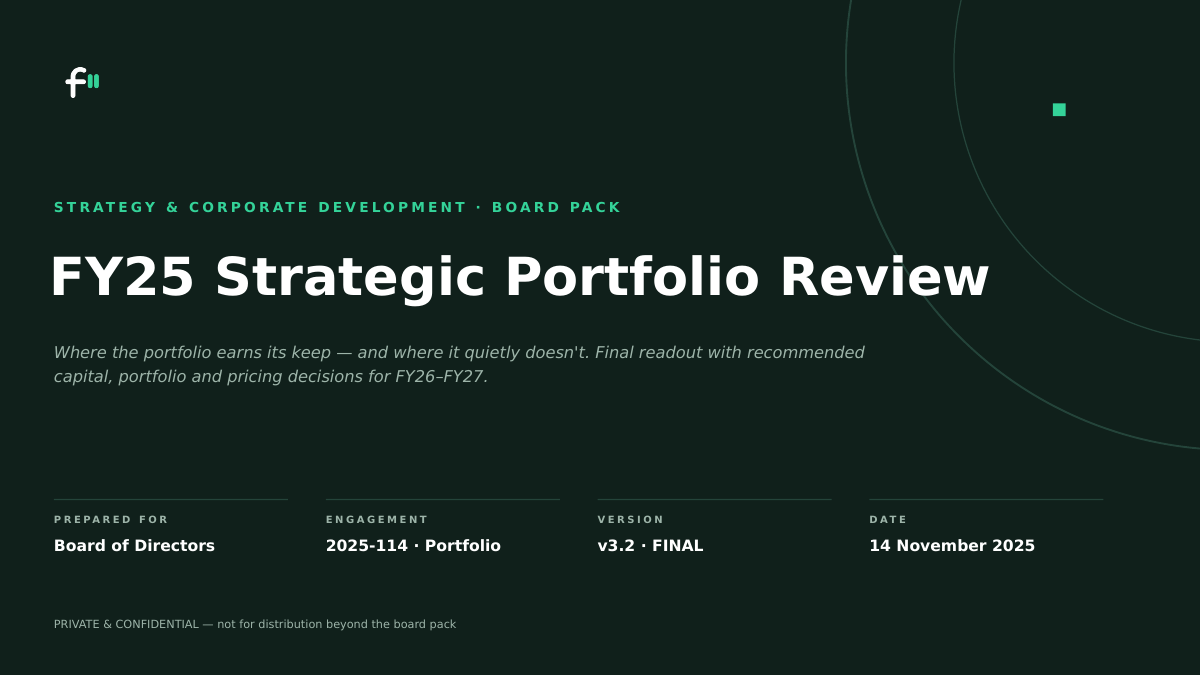
Brand deck cover
brand_deck.pptx · fonts, grid, voice
* Fair-test note: the web tool reads your PPTX only as a theme — colors, fonts, logo. The general-purpose AI reads both files whole — story and brand deck. Effigo reads the brand deck as a full system: layout grid, decorative language, chart styling and the voice your company writes in. Same inputs to all three; how deep each one goes is the test.
Pick an exhibit and a rival — every result opened in PowerPoint, same brief
Exhibit
Effigo vs
Effigonative
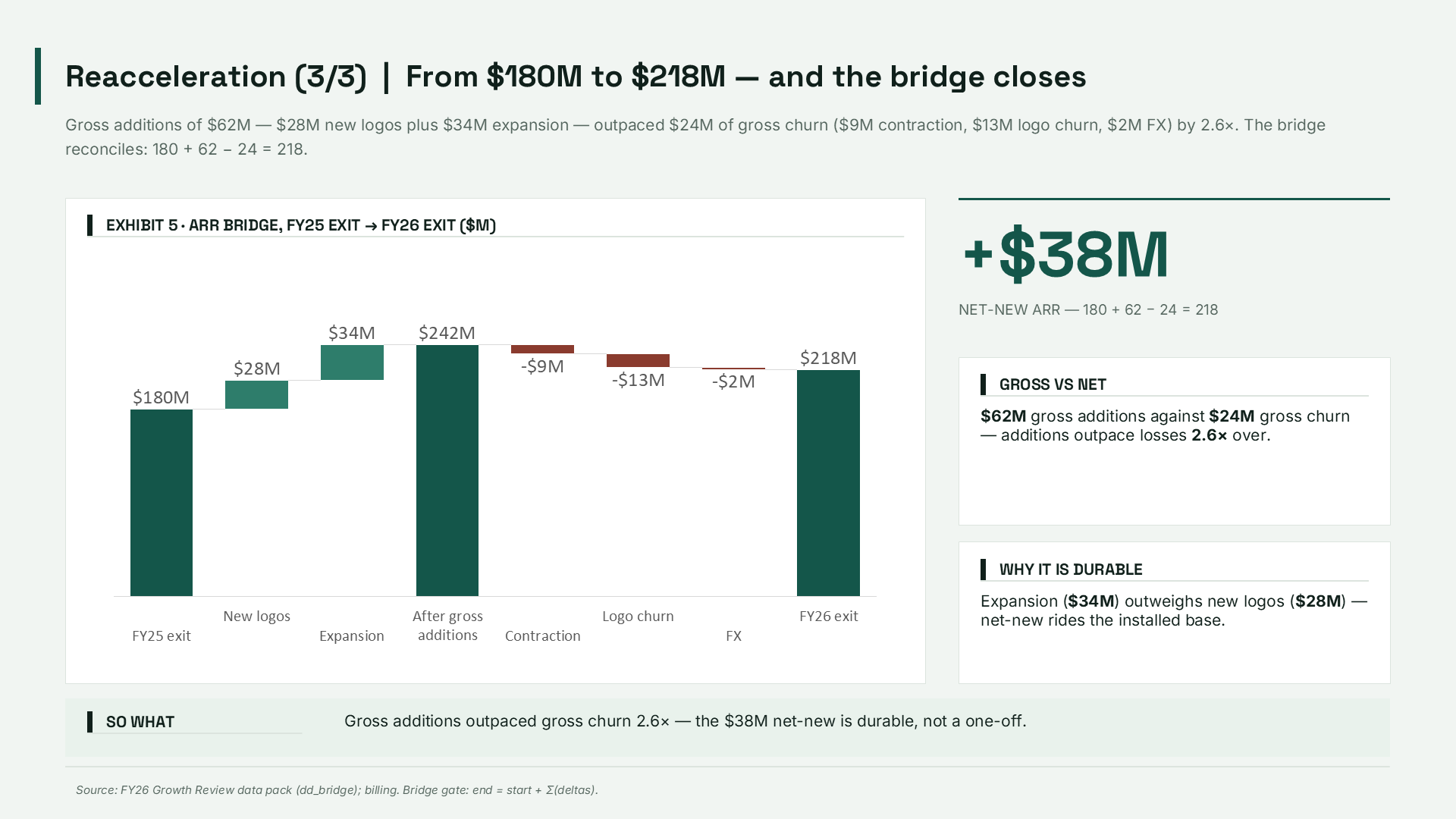
Effigo exhibit opened in PowerPoint
a native, editable chart — even the most complex ones the bridge adds up: 180 + 62 − 24 = 218
General-purpose AI chatbotstatic shapes
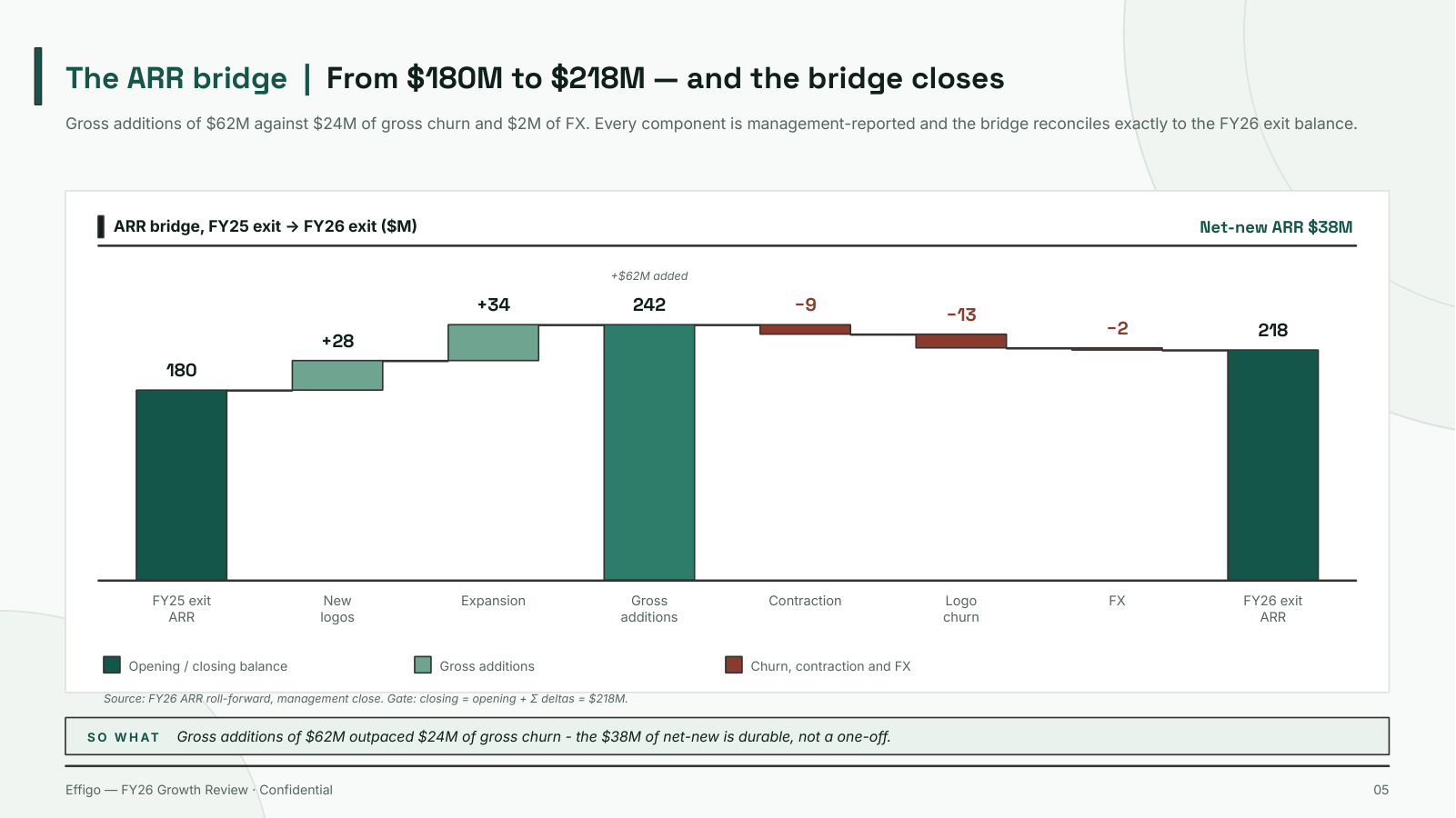
Competitor exhibit opened in PowerPoint
~ it closes correctly — but it's static shapes, not a chart brand font not embedded in the file
~3h
to a deck at your standard
1–2 vs 7+
iterations to ship — us vs the field
100%
editable in PowerPoint
0
repair pop-ups on open
0
numbers invented in silence — traceable or flagged

Numbers from published reviews and our own head-to-head — the full, reproducible test, with inputs and outputs published, lands at beta.

/ what ships with the beta

Built PowerPoint-first.

BETA

Story to structure

The core loop: send your narrative as plain text — and optionally a spreadsheet of data — and Effigo structures the argument slide by slide, in your voice.

BETA

Brand layer from your deck

Fonts, colors, logo, grid and voice — extracted from one example PPTX and enforced on every slide.

BETA

Numbers wired to your data

Chart series and key figures resolve from your spreadsheet at build time — deterministic arithmetic, no retyping. Every build ships with a numeral audit: figures the AI wrote itself are flagged for review.

BETA

Native charts & diagrams

Columns, lines, part-whole, scatter, funnels, matrices, timelines — real PowerPoint objects with live data.

BETA

Complex charts, still native

Waterfall ships today as a real, editable PowerPoint chart — and by launch the rest of the complex library follows. Where a type has no native form, we build it as data-true editable shapes — never a flat image.

BETA

Native decorative layer

Curves, strokes, ticks and frames generated as editable shapes — your brand's visual texture, never a background image.

SOON

Guided iteration

Ask for changes in plain language — "tighten slide 7", "make the funnel a table" — and the deck updates in place, still fully native.

SOON

Shared workspaces

One brand profile, whole team: colleagues from the same company generate and iterate decks in a shared space — identity enforced for everyone.

SOON

Story co-writing

No storytelling file ready? Effigo helps you build it — even starting from a financial model. Send the spreadsheet, point at the angle you want, and it drafts the narrative for you to approve before any slide exists.

SOON

Deck refresh

Point at last quarter's deck, plug in new data, get this quarter's — same look, updated story.

/ pricing

Pay per use. No subscription.

No monthly plan, no seats, no minimums — and no mystery about what a deck will cost. The entire price structure fits on one line:

setup
one-time · your brand profile, built from one deck you love
one-time feeon us for the first brands off the waitlist
+
slides × tier
per deck · you choose the length and the tier
the only thing you ever pay, deck by deck
EARLY ACCESS

Setup fee waived for the first brands we onboard. Once those slots fill, setup goes back on the price list.

Lite
$ / slide · announced at beta

Fast, solid decks for internal use. Full brand enforcement, lighter design and narrative pass.

Full
$$ / slide · announced at beta

The full system: layout intelligence, native charts and diagrams, decorative language, your writing voice.

Finest
$$$ / slide · announced at beta

Deepest narrative and design reasoning, for the decks where the stakes justify it.

You pick the tier per deck, not per contract — a 12-slide internal review and a 30-slide board deck don't have to cost the same way. Exact per-slide pricing is announced with the beta.

Every deck, faithfully yours.
Every number, accounted for.

Be first to run the test on your own brand and your own data — with setup on us.